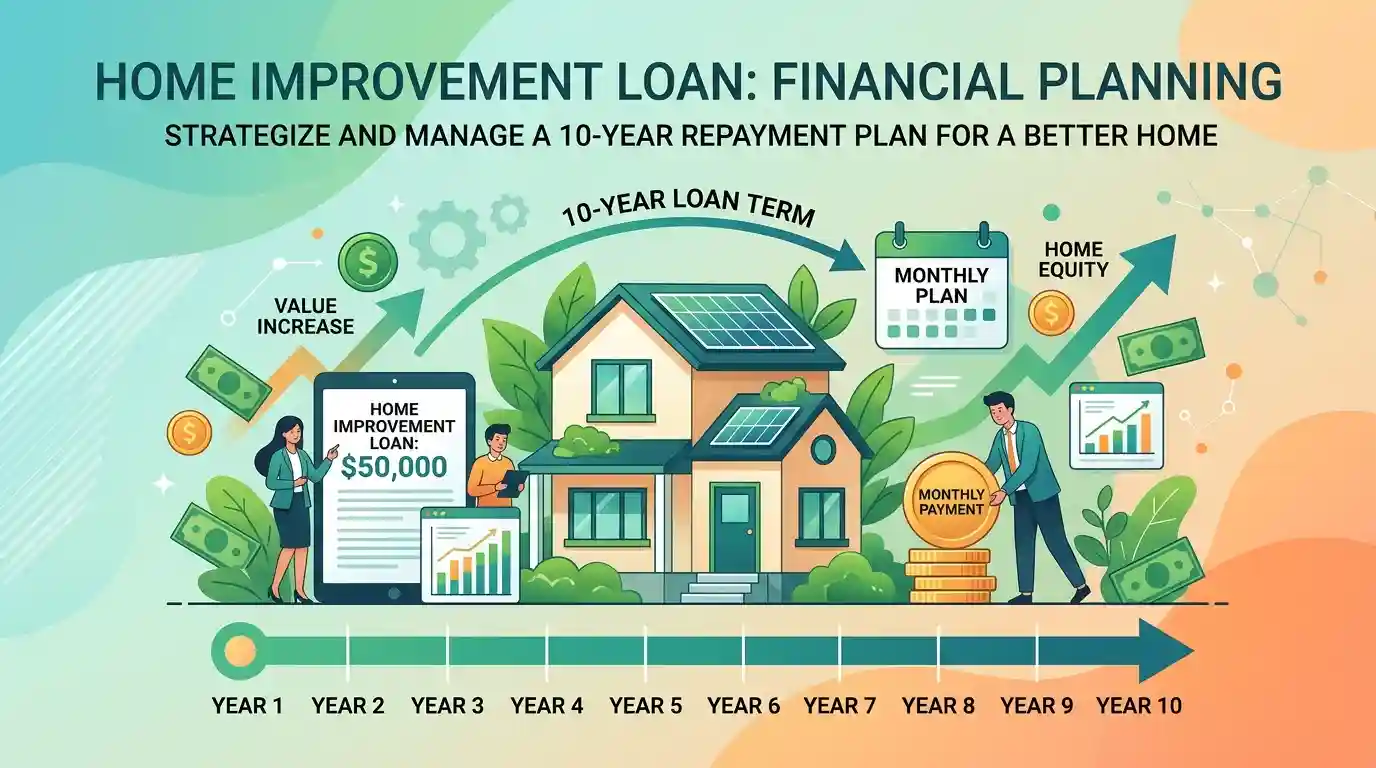
A 10 year home improvement loan is financing that allows homeowners to repay renovation or repair costs over 120 monthly payments. It can help cover projects such as kitchen remodeling, roofing, flooring, and home additions. Depending on the lender, borrowers may qualify through personal loans, home equity loans, or other financing programs.
Thank you for reading this post, don't forget to subscribe!Key Takeaways
- A 10-year home improvement loan spreads renovation costs over 120 months.
- Home equity loans and HELOCs may offer longer repayment options.
- Unsecured personal loans generally have shorter repayment periods.
- Your credit score, income, debt, and home equity can affect approval and interest rates.
- Always compare APR, fees, monthly payments, and total borrowing costs before signing.
10 year home improvement loan
Introduction
Home renovations can make a house more comfortable, functional, and valuable. However, projects such as replacing a roof, remodeling a kitchen, upgrading a bathroom, or adding another room can cost thousands of dollars.
If you do not have enough savings to cover these expenses, financing may help. A 10 year home improvement loan gives you a longer repayment period, allowing you to spread renovation costs across 120 monthly payments instead of paying everything upfront.
Homeowners often look for this type of financing because smaller monthly payments can make large projects easier to manage. However, a longer loan term can also increase the total interest you pay.
This guide explains how 10-year home improvement loans work, where to find them, what they cost, and how to choose financing that fits your budget.
What Does “10 Year Home Improvement Loan” Mean?
A 10-year home improvement loan is a financing arrangement that gives you ten years to repay borrowed money for eligible home renovation or repair expenses.
The repayment period usually includes 120 monthly payments. Depending on the loan type, you may receive the money as a lump sum or access it through a revolving credit line.
Common projects financed with these loans include:
- Kitchen and bathroom remodeling.
- Roof replacement and structural repairs.
- New windows, doors, and flooring.
- Basement finishing and room additions.
- Plumbing, electrical, and heating upgrades.
- Energy-efficient home improvements.
Not every lender offers a ten-year repayment term. Some personal loans have shorter limits, while certain home equity products offer longer repayment periods.
Why Consider a 10-Year Home Improvement Loan?
A longer repayment period can make expensive renovation projects easier to manage. Instead of paying a large amount upfront, you can spread the cost over several years.
Here are the main benefits:
- Lower monthly payments: Longer repayment periods can reduce your required monthly payment.
- Budget flexibility: You can keep more money available for regular household expenses.
- Large project financing: You may have access to enough money for major repairs or renovations.
- Predictable payments: Fixed-rate loans provide consistent principal and interest payments.
- Flexible financing choices: You can compare secured and unsecured borrowing options.
However, a longer term usually means paying more interest over the life of the loan.
10 Best Ways to Finance Home Improvements for 10 Years
Not every financing option works the same way. Here are ten options worth comparing when you want a ten-year repayment period.
1. Home Equity Loan
Meaning: A home equity loan allows you to borrow against the equity you have built in your property. You typically receive the approved amount in one lump sum and repay it through scheduled payments.
Best For: Formal, Professional
Example 1: A homeowner borrows $35,000 to replace an aging roof and renovate two bathrooms.
Example 2: A family uses a fixed-rate home equity loan to finance a basement renovation.
Quick Tip: Ask your lender whether it offers a 10-year repayment term and compare closing costs. Your home serves as collateral, so missed payments can put your property at risk. Consumer Financial Protection Bureau+1
2. Home Equity Line of Credit (HELOC)
Meaning: A HELOC provides access to a revolving credit line based on your home equity. You can borrow money as needed during the draw period and repay the outstanding balance under the agreement.
Best For: Professional, Flexible
Example 1: A homeowner uses a HELOC to pay contractors as different renovation stages are completed.
Example 2: A family draws money from its credit line to replace windows and upgrade electrical systems.
Quick Tip: Do not confuse a 10-year draw period with a 10-year repayment period. Many HELOCs have separate borrowing and repayment stages, and their interest rates are often variable. Consumer Financial Protection Bureau+1
3. Long-Term Personal Loan
Meaning: A personal loan provides a fixed amount of money that you repay through regular installments. Most home improvement personal loans are unsecured, meaning they do not require your home as collateral.
Best For: Professional, Friendly
Example 1: A homeowner borrows $20,000 to update an outdated kitchen.
Example 2: A couple uses personal loan financing to replace damaged flooring throughout their house.
Quick Tip: Check the maximum repayment term before applying. Many personal loan providers offer terms of two to seven years rather than ten. NerdWallet+1
4. FHA Title I Property Improvement Loan
Meaning: The FHA Title I Property Improvement Loan program helps eligible homeowners finance certain repairs and improvements through participating lenders.
Best For: Formal, Professional
Example 1: A homeowner explores Title I financing to repair an older property.
Example 2: A property owner contacts an approved lender to ask about financing eligible home improvements.
Quick Tip: Check current program limits and lender participation. HUD explains that qualifying single-family property improvement loans can have terms of up to 20 years and 32 days, so a ten-year term may be possible. HUD+1
5. Fixed-Rate Renovation Loan
Meaning: A fixed-rate renovation loan provides financing with an interest rate that stays the same throughout the agreed repayment period.
Best For: Professional, Formal
Example 1: A homeowner chooses fixed-rate financing for a major bathroom renovation.
Example 2: A family prefers stable monthly payments while paying for a new roof.
Quick Tip: Compare the APR rather than looking only at the advertised interest rate. Fees can increase the actual borrowing cost.
6. Credit Union Home Improvement Loan
Meaning: Credit unions offer financing to eligible members for different home repair and renovation projects. Some provide secured or unsecured loans with flexible terms.
Best For: Friendly, Professional
Example 1: A homeowner contacts a local credit union to compare renovation financing.
Example 2: A borrower checks whether membership provides access to a lower loan rate.
Quick Tip: Ask about membership requirements, origination fees, loan limits, and whether ten-year repayment is available.
7. Cash-Out Mortgage Refinance
Meaning: A cash-out refinance replaces your existing mortgage with a larger mortgage and allows you to receive part of the difference in cash.
Best For: Formal, Professional
Example 1: A homeowner refinances an existing mortgage and uses the available cash for a home addition.
Example 2: A property owner compares refinancing costs before financing a large renovation.
Quick Tip: Compare the new mortgage rate, closing costs, and total repayment period. Refinancing may be expensive if your existing mortgage has a lower rate.
8. Contractor Financing
Meaning: Some home improvement contractors partner with lenders to offer financing for renovation projects. These arrangements may include installment loans or promotional payment plans.
Best For: Friendly, Professional
Example 1: A homeowner reviews financing offered by a roofing contractor.
Example 2: A family compares a contractor’s payment plan with a bank loan before remodeling its kitchen.
Quick Tip: Read the financing agreement independently of the construction contract. Check promotional interest periods, deferred interest, and late-payment charges.
9. Secured Home Improvement Loan
Meaning: A secured loan requires collateral to support the borrowing agreement. Depending on the lender, collateral may include home equity or another eligible asset.
Best For: Formal, Professional
Example 1: A homeowner considers a secured loan to finance extensive structural repairs.
Example 2: A borrower compares secured and unsecured offers before selecting renovation financing.
Quick Tip: A lower interest rate does not automatically make a secured loan better. Understand exactly what property the lender can claim if you fail to repay.
10. Energy-Efficient Home Improvement Financing
Meaning: Energy improvement financing helps homeowners pay for upgrades that can reduce energy use, such as insulation, efficient heating systems, windows, and solar equipment.
Best For: Friendly, Professional
Example 1: A homeowner finances new insulation and energy-efficient windows.
Example 2: A family explores financing for an upgraded heating and cooling system.
Quick Tip: Ask whether local utilities, state programs, or participating lenders offer special financing. Check eligibility before starting the project.
Comparison Table
| Financing option | Best used for | Typical consideration |
|---|---|---|
| Home equity loan | Large renovations | Fixed or variable rate |
| HELOC | Projects completed in stages | Often variable rate |
| Personal loan | Smaller renovations | Usually shorter terms |
| FHA Title I | Eligible repairs | Government-insured program |
| Fixed-rate renovation loan | Predictable payments | Stable interest rate |
| Credit union loan | Comparing member offers | Membership requirements |
| Cash-out refinance | Major renovations | Mortgage closing costs |
| Contractor financing | Contractor-led projects | Promotional terms |
| Secured loan | Larger borrowing needs | Collateral risk |
| Energy improvement financing | Efficiency upgrades | Program eligibility |
How Much Does a 10-Year Home Improvement Loan Cost?
Your monthly payment depends on the amount borrowed, APR, fees, and repayment period.
For example, here is what a $20,000 loan could cost over ten years at three hypothetical fixed interest rates.
| APR | Monthly payment | Total interest |
|---|---|---|
| 8% | $242.66 | $9,118.62 |
| 10% | $264.30 | $11,716.18 |
| 12% | $286.94 | $14,433.03 |
Illustrative estimates for 120 monthly payments. They exclude additional fees and assume a fixed interest rate.
As the table shows, even a small difference in interest rates can change your total borrowing cost significantly.
Before accepting an offer, ask for a complete payment schedule and review the APR, origination fees, and any prepayment penalties.
How to Qualify for a 10-Year Home Improvement Loan
Lenders use several factors to decide whether you qualify and what interest rate to offer.
Credit score: A stronger credit history may help you qualify for more competitive rates. Requirements vary by lender and loan type.
Income: Lenders review your income to determine whether you can manage the monthly payments.
Debt-to-income ratio: Your existing monthly debt payments compared with your gross monthly income can affect approval.
Home equity: Secured financing generally requires sufficient available equity in your property.
Property value: Some lenders require an appraisal to estimate the property’s current value.
Prepare documents such as income statements, identification, mortgage information, and renovation estimates before applying.
Common Mistakes to Avoid
Before choosing a loan, watch out for these common mistakes:
- Focusing only on monthly payments: A lower payment can hide a much higher total interest cost over ten years.
- Ignoring origination fees: Some lenders deduct fees from the approved amount, leaving you with less money than expected.
- Choosing variable rates without understanding them: HELOC payments can increase when interest rates change.
- Borrowing more than necessary: Extra borrowing increases interest costs and can put pressure on your monthly budget.
- Overlooking collateral risks: Missing payments on a home equity loan or other property-secured financing can put your home at risk.
Frequently Asked Questions
1. Can you get a 10-year home improvement loan?
Yes. Some banks, credit unions, mortgage lenders, and government-insured loan programs offer financing with ten-year repayment periods. Home equity loans are one option. Always confirm the available term with the lender before applying.
2. What is the best loan for home improvements over 10 years?
A home equity loan may work well if you have sufficient equity and want predictable payments. However, an unsecured loan may be better if you do not want to use your property as collateral. Compare APRs and fees.
3. What credit score do I need for a home improvement loan?
There is no single credit score requirement for every home improvement loan. Some lenders accept borrowers with fair credit, while others prefer stronger credit histories. Your income, existing debts, loan amount, and collateral can also affect approval.
4. Can I get a home improvement loan without equity?
Yes. Some personal loans and contractor financing programs do not require home equity. These options may have higher interest rates or shorter repayment periods, so compare the complete borrowing costs before choosing one.
5. Are 10-year home improvement loans tax-deductible?
Interest on a qualifying home equity loan may be tax-deductible when the money is used to buy, build, or substantially improve the home securing the loan. Other requirements and deduction limits apply. Consult a tax professional. Internal Revenue Service+1
6. Can I pay off a home improvement loan early?
Many lenders allow early repayment, but some agreements may include prepayment penalties. Review your loan documents before making extra payments. Paying early can reduce the total interest you pay if no significant penalty applies.
7. Is a HELOC better than a home improvement loan?
It depends on your project. A HELOC can provide flexible access to money for renovations completed in stages. A fixed-rate home equity loan may be more suitable when you need one lump sum and want predictable payments.
8. Can I use a home improvement loan for any renovation?
Many lenders allow financing for kitchens, bathrooms, roofing, flooring, and structural repairs. However, eligible expenses depend on the loan agreement and program rules. Government-backed financing may have additional restrictions on how you use the funds.
Conclusion
A 10 year home improvement loan can make major renovation projects more affordable by spreading payments across 120 months. It may be useful for homeowners planning kitchen remodeling, roof replacement, bathroom upgrades, or other expensive improvements.
The right financing option depends on your credit profile, available home equity, income, and renovation budget. A home equity loan may offer predictable payments, while a HELOC provides flexible access to funds. Personal loans and government-insured programs are also worth exploring.
Before signing an agreement, compare interest rates, APRs, fees, monthly payments, and total repayment costs. Most importantly, make sure the monthly payment fits comfortably within your budget.