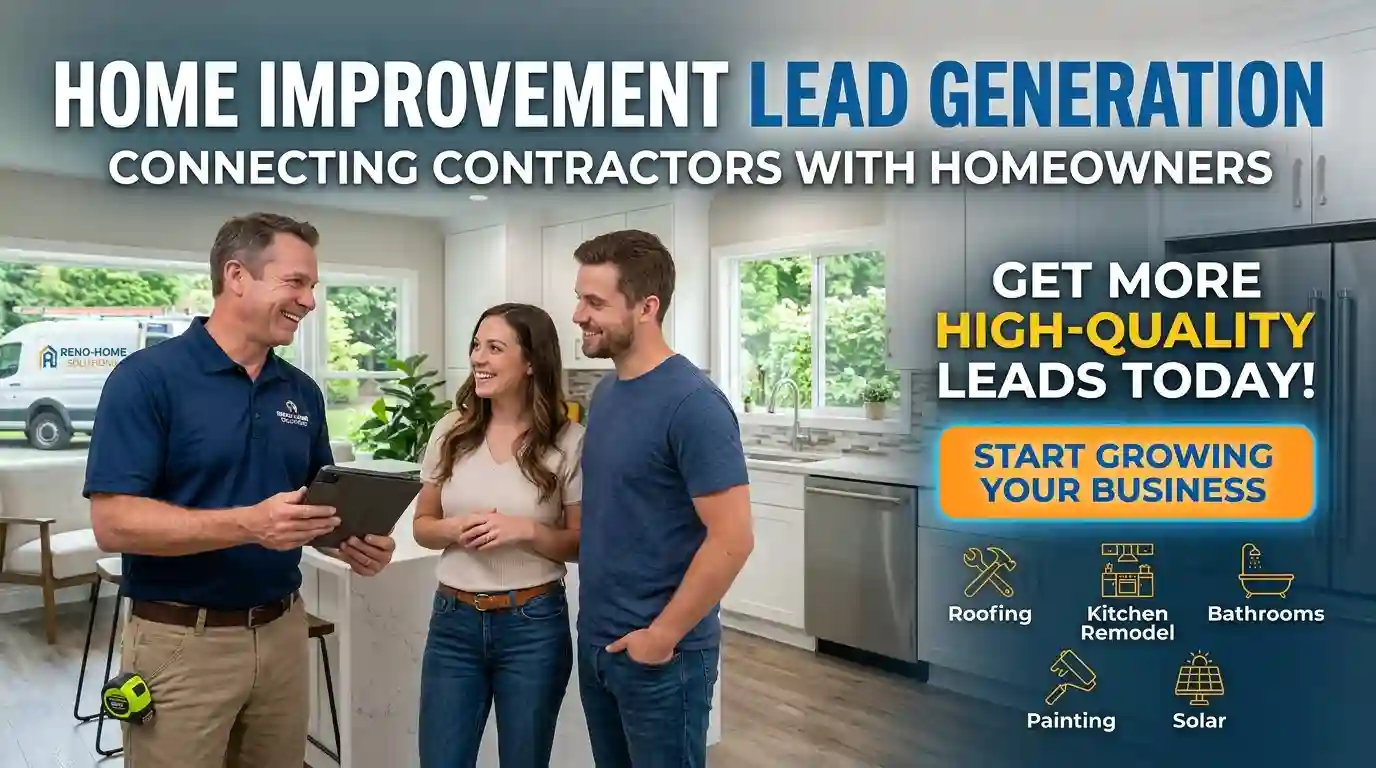
Home improvement lead generation is the process of attracting homeowners who need services such as remodeling, roofing, painting, HVAC installation, or bathroom renovations. Contractors can generate leads through local SEO, paid advertising, referrals, social media, and lead generation platforms. The best strategy combines qualified prospects, fast follow-up, and consistent tracking to turn inquiries into paying customers.
Thank you for reading this post, don't forget to subscribe!Key Takeaways
- Use local SEO and a complete Google Business Profile to attract homeowners searching for nearby contractors.
- Create service-specific landing pages with clear calls to action.
- Combine referrals, paid ads, and organic marketing instead of relying on one source.
- Qualify leads by checking their project needs, location, budget, and timeline.
- Track lead quality, conversion rates, and customer acquisition costs to improve results.
Home Improvement Lead Generation
Introduction
Finding homeowners who are ready to hire a contractor can be challenging. Competition is strong in the home improvement industry, and many businesses compete for the same roofing, remodeling, painting, flooring, and renovation projects. Without a reliable marketing strategy, contractors may experience slow periods, spend too much on advertising, or receive inquiries from people who are not ready to buy.
Home improvement lead generation helps contractors connect with homeowners who need specific services. It includes attracting potential customers through search engines, paid advertising, referrals, social media, and dedicated lead generation services.
However, getting more inquiries does not always mean getting more business. The real goal is to attract suitable homeowners, respond quickly, provide accurate estimates, and win profitable projects. This guide explains practical lead generation methods, how to evaluate lead quality, common mistakes to avoid, and ways to measure marketing performance.
What Does “Home Improvement Lead Generation” Mean?
Home improvement lead generation is the process of finding and attracting homeowners who may hire a contractor for a repair, upgrade, or renovation. A lead can be someone who calls your business, submits a website form, requests an estimate, or books a consultation.
Contractors use lead generation to find customers for services such as:
- Roofing and siding installation
- Kitchen and bathroom remodeling
- HVAC repair and replacement
- Flooring, painting, and window installation
- Home additions and exterior renovations
Lead generation is commonly used by independent contractors, remodeling companies, roofing businesses, and home service marketing agencies. Its purpose is to create a steady pipeline of potential customers rather than depend entirely on word of mouth.
Why Use Other Ways to Say “Home Improvement Lead Generation”?
The phrase has several related terms that may fit different marketing goals. Choosing the right wording can help contractors communicate with customers, organize campaigns, and target more specific searches.
For example, a roofing company may benefit from targeting “roofing leads,” while a remodeling business may focus on “remodeling lead generation.”
Using related terms can help you:
- Reach homeowners searching for a specific service.
- Make website headings and advertising copy more natural.
- Explain your marketing services to potential clients.
- Target more specific keywords without repeating the same phrase.
- Separate general inquiries from qualified sales opportunities.
10 Best Alternatives to “Home Improvement Lead Generation”
These alternatives describe closely related services or strategies. They are not always interchangeable, so choose one that matches your actual business activity.
1. Home Improvement Lead Generation Services
Meaning: This phrase describes companies or systems that help contractors attract homeowner inquiries. Services may include advertising, search engine optimization, lead capture, and appointment setting.
Best For: Professional, Formal
Example 1: Our home improvement lead generation services help remodeling companies connect with homeowners planning kitchen upgrades.
Example 2: Before hiring a marketing agency, compare its lead quality, pricing, and reporting process.
Quick Tip: Use this phrase when promoting a service that helps other home improvement businesses acquire customers.
2. Contractor Lead Generation
Meaning: Contractor lead generation focuses on attracting potential customers for construction, repair, installation, and renovation businesses. It can cover several trades rather than one home improvement category.
Best For: Professional, Formal
Example 1: Our contractor lead generation campaign targets homeowners looking for licensed renovation professionals.
Example 2: Local SEO helped the contractor improve visibility and attract more estimate requests.
Quick Tip: This is a useful broader term for agencies serving multiple contractor types.
3. Remodeling Lead Generation
Meaning: Remodeling lead generation attracts homeowners planning changes to existing spaces, such as kitchens, bathrooms, basements, and living rooms. These leads often need consultations and detailed project estimates.
Best For: Professional, Formal
Example 1: The remodeling company created a dedicated landing page to attract homeowners planning bathroom renovations.
Example 2: High-quality remodeling leads helped the business focus on larger projects instead of minor repairs.
Quick Tip: Use this phrase when your marketing focuses on renovation and remodeling projects.
4. Qualified Home Improvement Leads
Meaning: Qualified home improvement leads are inquiries that meet basic business requirements. These may include the homeowner’s location, requested service, budget, project timeline, and willingness to discuss an estimate.
Best For: Professional, Formal
Example 1: The sales team checks each inquiry before scheduling an in-home consultation.
Example 2: Qualified home improvement leads helped the company spend less time on projects outside its service area.
Quick Tip: Define your qualification criteria before paying a provider for leads.
5. Local Contractor Marketing
Meaning: Local contractor marketing helps a business attract customers within its service area. It includes local search optimization, customer reviews, neighborhood referrals, and geographically targeted advertising.
Best For: Professional, Friendly
Example 1: Local contractor marketing helped the roofing company reach homeowners in nearby communities.
Example 2: The business improved its local visibility by sharing project photos and collecting honest customer reviews.
Quick Tip: Use this term when discussing a broad marketing plan rather than lead generation alone.
6. Home Services Lead Generation
Meaning: Home services lead generation covers businesses that repair, maintain, install, or improve residential property systems. Depending on the campaign, it may include HVAC, plumbing, electrical, cleaning, and remodeling services.
Best For: Professional, Formal
Example 1: The agency built a home services lead generation campaign for several residential service providers.
Example 2: Better targeting helped the company attract homeowners looking for heating system replacements.
Quick Tip: Choose this phrase if your business serves several home service industries.
7. Roofing and Remodeling Leads
Meaning: This phrase refers to inquiries from homeowners interested in roof repairs, roof replacement, or renovation projects. It combines two service categories and works best when a business genuinely offers both.
Best For: Professional, Casual
Example 1: The contractor tracks roofing and remodeling leads separately to compare project value.
Example 2: A new service page helped the company attract homeowners planning exterior upgrades.
Quick Tip: For stronger search targeting, create separate pages for roofing and remodeling rather than combining unrelated services on one page.
8. Residential Construction Lead Generation
Meaning: Residential construction lead generation attracts people considering home additions, major renovations, new builds, and other substantial residential projects. It often involves longer sales cycles and more detailed consultations.
Best For: Professional, Formal
Example 1: The builder developed a residential construction lead generation plan for homeowners planning custom additions.
Example 2: Detailed project galleries helped potential customers understand the company’s construction capabilities.
Quick Tip: Use this phrase when targeting builders and contractors who handle larger residential projects.
9. Home Improvement Marketing
Meaning: Home improvement marketing includes the activities a business uses to promote its services and build customer awareness. Lead generation is one part of this wider process, alongside branding, reputation management, and customer retention.
Best For: Professional, Friendly
Example 1: The company updated its home improvement marketing plan to include local search and referral campaigns.
Example 2: Before increasing its advertising budget, the business reviewed which marketing channels produced completed jobs.
Quick Tip: Choose this term when discussing overall promotion, not just the collection of customer inquiries.
10. Home Renovation Customer Acquisition
Meaning: Home renovation customer acquisition describes the process of attracting potential clients and converting them into paying customers. It covers the full journey from initial discovery to consultation, estimate, and signed agreement.
Best For: Professional, Formal
Example 1: The renovation company improved customer acquisition by simplifying its quote request form.
Example 2: A structured follow-up process helped the sales team turn more consultations into signed projects.
Quick Tip: Use this phrase when your focus includes both attracting prospects and converting them into customers.
Comparison Table
| Alternative | Best Used In | Tone |
|---|---|---|
| Home Improvement Lead Generation Services | Agency service pages | Professional |
| Contractor Lead Generation | Contractor marketing guides | Professional |
| Remodeling Lead Generation | Renovation campaigns | Professional |
| Qualified Home Improvement Leads | Lead qualification and sales | Formal |
| Local Contractor Marketing | Local SEO and promotion | Friendly |
| Home Services Lead Generation | Multi-trade campaigns | Professional |
| Roofing and Remodeling Leads | Trade-specific campaigns | Casual |
| Residential Construction Lead Generation | Builder marketing | Formal |
| Home Improvement Marketing | General marketing plans | Friendly |
| Home Renovation Customer Acquisition | Sales strategy and reporting | Formal |
Common Mistakes
1. Treating every alternative as an exact synonym. Home improvement marketing covers more activities than lead generation, while qualified leads describe a specific type of prospect.
2. Using broad keywords for specialized services. A roofing company may attract more relevant visitors with roofing-specific pages than with a general home improvement page alone.
3. Focusing on lead volume instead of quality. Hundreds of inquiries have little value if most homeowners are outside your service area or cannot afford the projects you offer.
4. Ignoring the customer journey. Generating an inquiry is only the beginning. Contractors must respond, schedule estimates, explain their services, and follow up professionally.
5. Making unsupported marketing claims. Avoid promises such as guaranteed sales or a fixed number of leads unless you can support them. Advertising claims should be truthful and evidence-based, as explained by the Federal Trade Commission.
Federal Trade Commission+1
Frequently Asked Questions
1. What is the best way to generate home improvement leads?
Start with local SEO, a complete Google Business Profile, customer referrals, and service-specific website pages. Add paid search advertising when you need more inquiries quickly. Track which channels produce qualified prospects and completed jobs, then invest more in the sources that deliver profitable results.
2. How do home improvement companies get qualified leads?
Companies qualify leads by asking about the requested service, property location, project scope, budget, and expected start date. They can collect this information through website forms or initial phone calls. Clear qualification rules help sales teams focus on realistic projects instead of unsuitable inquiries.
3. Are home improvement leads worth buying?
Purchased leads can help contractors reach homeowners without building every marketing channel from scratch. However, results depend on the provider, price, exclusivity, and lead quality. Before buying, ask whether leads are shared, how they are verified, and what happens when contact details are invalid.
4. What is the difference between exclusive and shared leads?
An exclusive lead is sold or assigned to one contractor under the provider’s stated terms. A shared lead goes to multiple businesses, which may create more competition for the same homeowner. Confirm the provider’s definition of exclusivity before purchasing, because policies vary.
5. How much does home improvement lead generation cost?
Costs vary by trade, location, advertising competition, project value, and marketing channel. Referrals may require little direct spending, while paid advertising and third-party lead services require an ongoing budget. Calculate your cost per qualified lead and cost per booked job instead of relying on a universal price estimate.
6. Is SEO better than paid advertising for contractors?
SEO can build lasting visibility and attract homeowners who actively search for services, but it usually takes time to gain traction. Paid ads can bring traffic sooner but require continued spending. Many contractors use paid campaigns for immediate demand while building organic visibility for longer-term growth.
7. Which businesses need home improvement lead generation?
Roofers, remodelers, painters, flooring installers, HVAC companies, window replacement specialists, and general contractors can all benefit. The best approach depends on project size, service area, seasonal demand, and customer behavior. A business handling major renovations may need a different sales process than one offering emergency repairs.
8. How can contractors turn more leads into customers?
Respond promptly, ask clear questions, schedule estimates efficiently, and explain the next steps. Use a customer relationship management system, or CRM, to track calls, estimates, follow-ups, and sales outcomes. Reviewing this information helps contractors identify where prospects drop out and improve the process.
Conclusion
Home improvement lead generation works best when contractors focus on attracting the right homeowners and turning their interest into real projects. Local SEO, referrals, targeted advertising, and trustworthy service pages can all contribute to a steady flow of inquiries.
The best alternative phrase depends on your goal. Choose contractor lead generation for a broad industry topic, remodeling lead generation for renovation services, and qualified home improvement leads when discussing prospect quality. Use home improvement marketing when covering the wider promotional strategy.
Remember that generating inquiries is only one part of growing a contracting business. Strong follow-up, clear estimates, honest communication, and careful performance tracking help turn marketing efforts into measurable results.

I am a fan of thrilling mysteries inspired by the genius storytelling of Dan Brown, exploring secrets, symbols, and suspense while sharing exciting stories on flirtzdream.com.