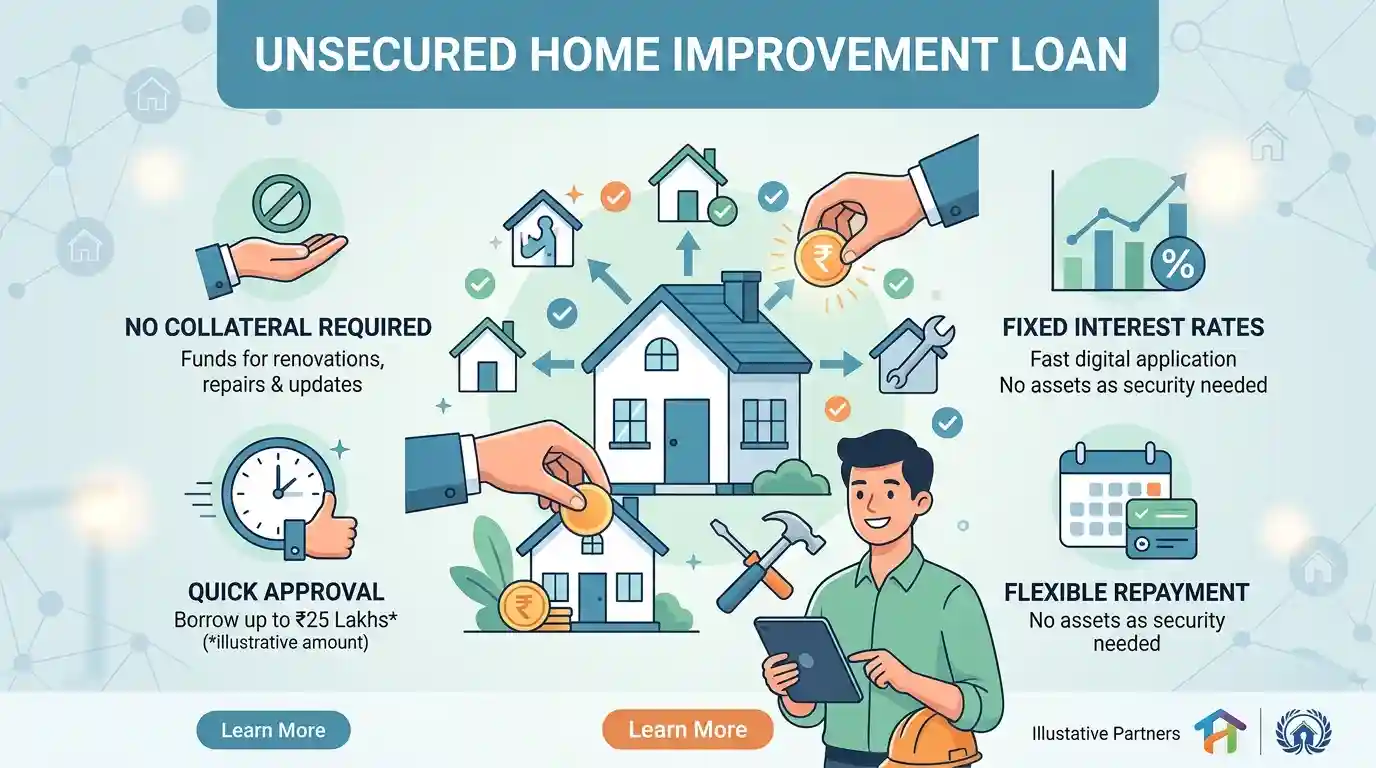
An unsecured home improvement loan is a personal loan used to pay for home repairs, upgrades, or renovations without putting your house up as collateral. Approval usually depends on your credit score, income, and existing debts. You can use the funds for projects such as kitchen remodeling, roof repairs, painting, or energy-efficient upgrades.
Thank you for reading this post, don't forget to subscribe!Key Takeaways
- An unsecured home improvement loan does not require your home as collateral.
- Lenders generally review your credit history, income, and debt-to-income ratio.
- Interest rates and loan limits vary by lender and borrower qualifications.
- Personal loans can fund many repairs, but some lenders restrict certain uses.
- Comparing the APR, fees, repayment term, and monthly payment helps you make an informed decision.
Unsecured Home Improvement Loan
Home repairs can be expensive, especially when you need a new roof, updated plumbing, or a more functional kitchen. If you do not have enough savings to cover these costs, an unsecured home improvement loan may help you pay for the work over time without using your house as collateral.
Unlike a home equity loan, this type of financing does not require you to borrow against the value of your property. Instead, lenders generally evaluate your credit history, income, existing debts, and ability to repay the loan.
However, borrowing without collateral does not automatically mean borrowing cheaply. Interest rates, origination fees, repayment periods, and eligibility requirements can differ significantly between lenders.
This guide explains how unsecured home improvement loans work, what they can cover, how to qualify, and how to compare financing options. You will also learn about potential drawbacks and practical ways to avoid borrowing more than you can comfortably repay.
What Does an Unsecured Home Improvement Loan Mean?
An unsecured home improvement loan is typically a personal installment loan used to pay for home repairs, maintenance, remodeling, or upgrades. The lender does not take your home as collateral, so you do not need to pledge your property to secure the debt.
You usually receive a lump sum and repay it through scheduled monthly payments. Depending on the loan agreement, the interest rate may be fixed or variable, although many personal loans offer fixed rates.
Homeowners commonly use these loans for:
- Kitchen and bathroom renovations
- Roof repairs and replacement
- Flooring, painting, and interior updates
- Plumbing and electrical work
- Heating and cooling system repairs
- Accessibility improvements
- Certain energy-efficient home upgrades
Loan proceeds may be paid directly to you or, in some cases, to a contractor. Check the lender’s rules before applying because permitted uses and payment arrangements vary.
Why Use an Unsecured Home Improvement Loan?
An unsecured loan can make sense when you need funds for an important project but do not want to use your property as security.
Potential benefits include:
- No home collateral: Your house is not pledged to secure the loan.
- Predictable payments: Fixed-rate loans provide a consistent principal-and-interest payment.
- Potentially faster funding: Some lenders offer quick decisions and funding, depending on verification requirements.
- No home equity requirement: You may qualify without substantial equity in your property.
- Flexible project choices: Many personal loans can cover several types of repairs and improvements.
Still, an unsecured loan is not necessarily the cheapest option. Because the lender has no property securing the debt, the interest rate may be higher than that of some secured financing options. Missing payments can also damage your credit and lead to collection activity.
10 Best Other Ways to Say “Unsecured Home Improvement Loan”
The following terms describe similar financing options. They are not always interchangeable, so choose wording that accurately reflects the lender’s actual product.
1. Unsecured Home Renovation Loan
Meaning: This phrase describes a loan used to renovate or update a home without pledging the property as collateral. It is especially suitable for larger projects involving kitchens, bathrooms, or multiple rooms.
Best For: Professional, Formal
Example 1: We applied for an unsecured home renovation loan to update our outdated kitchen.
Example 2: An unsecured home renovation loan may help cover the cost of new flooring and bathroom fixtures.
Quick Tip: Use this phrase when the primary purpose is remodeling rather than routine maintenance.
2. Personal Loan for Home Repairs
Meaning: This term describes a personal loan used to pay for necessary home repairs. Depending on the lender’s terms, it may cover plumbing problems, roof damage, or a broken heating system.
Best For: Professional, Casual
Example 1: A personal loan for home repairs helped us budget for the damaged roof.
Example 2: Compare several lenders before choosing a personal loan for home repairs.
Quick Tip: This wording works well when explaining financing for essential fixes.
3. No-Collateral Home Improvement Loan
Meaning: This phrase highlights the loan’s main feature: you do not have to pledge your home or another asset as security. It is a straightforward way to explain unsecured financing to borrowers.
Best For: Formal, Professional
Example 1: A no-collateral home improvement loan may suit homeowners who want to preserve their home equity.
Example 2: Ask the lender whether the no-collateral home improvement loan includes an origination fee.
Quick Tip: Confirm that the specific loan does not require collateral before using this description.
4. Unsecured Home Repair Loan
Meaning: This term focuses on financing repairs without securing the debt against your property. It is particularly relevant when a homeowner needs to address damage or replace a failing home system.
Best For: Professional, Formal
Example 1: The homeowner explored an unsecured home repair loan after discovering a plumbing leak.
Example 2: An unsecured home repair loan could help cover urgent maintenance costs.
Quick Tip: Use this phrase when repairs, rather than decorative upgrades, are the main concern.
5. Personal Home Improvement Loan
Meaning: A personal home improvement loan is a personal loan intended for renovation or upgrade expenses. It may be unsecured, but you should check the contract rather than assume every product with this name works the same way.
Best For: Professional, Friendly
Example 1: We compared personal home improvement loans before replacing our kitchen cabinets.
Example 2: A personal home improvement loan offered a repayment schedule that fit our budget.
Quick Tip: Clarify whether the product is secured or unsecured when discussing a specific lender.
6. Home Remodeling Loan Without Collateral
Meaning: This descriptive phrase refers to financing for remodeling projects that does not use property as security. It clearly communicates both the purpose of the loan and its collateral requirements.
Best For: Formal, Professional
Example 1: They searched for a home remodeling loan without collateral to finance their living room renovation.
Example 2: A home remodeling loan without collateral may be an option for borrowers who lack substantial home equity.
Quick Tip: This wording is useful when readers specifically want to avoid borrowing against their property.
7. Unsecured Renovation Financing
Meaning: Unsecured renovation financing is a broad term for borrowing money to improve a property without pledging collateral. Depending on the provider, it may describe a personal loan or another eligible financing arrangement.
Best For: Professional, Formal
Example 1: The family reviewed unsecured renovation financing before expanding their home office.
Example 2: Unsecured renovation financing can offer an alternative to borrowing against home equity.
Quick Tip: Use this broader term when comparing several types of unsecured funding.
8. Home Improvement Personal Loan
Meaning: This phrase describes a personal loan used to fund eligible home projects. Many such loans provide a lump sum with scheduled repayments, although the interest rate and terms depend on the lender.
Best For: Professional, Friendly
Example 1: A home improvement personal loan helped cover the cost of replacing old windows.
Example 2: Check the total repayment amount before accepting a home improvement personal loan.
Quick Tip: This is a natural phrase for consumer guides and loan comparisons.
9. Home Upgrade Loan Without Home Equity
Meaning: This phrase describes financing that does not require you to borrow against existing home equity. It is useful for homeowners who have limited equity but still meet a lender’s eligibility requirements.
Best For: Friendly, Professional
Example 1: A home upgrade loan without home equity may be worth exploring after buying a property recently.
Example 2: We looked into a home upgrade loan without home equity to replace our aging air conditioner.
Quick Tip: Lack of an equity requirement does not mean the lender will approve every applicant.
10. Non-Home-Secured Renovation Loan
Meaning: This technical-sounding phrase emphasizes that the home itself does not secure the renovation debt. It may be useful when comparing unsecured personal loans with home equity products.
Best For: Formal, Professional
Example 1: The borrower preferred a non-home-secured renovation loan to avoid pledging the property.
Example 2: Review the agreement carefully before accepting a non-home-secured renovation loan.
Quick Tip: For general readers, “unsecured home renovation loan” is usually clearer and more natural.
Comparison Table
| Alternative | Best Used In | Tone |
|---|---|---|
| Unsecured home renovation loan | Remodeling guides | Professional |
| Personal loan for home repairs | Repair advice | Practical |
| No-collateral home improvement loan | Loan comparisons | Formal |
| Unsecured home repair loan | Emergency repairs | Direct |
| Personal home improvement loan | Consumer finance | Friendly |
| Home remodeling loan without collateral | Remodeling finance guides | Descriptive |
| Unsecured renovation financing | Financing comparisons | Professional |
| Home improvement personal loan | Loan applications and guides | Natural |
| Home upgrade loan without home equity | First-time homeowner guides | Friendly |
| Non-home-secured renovation loan | Technical comparisons | Formal |
Common Mistakes When Choosing an Unsecured Home Improvement Loan
1. Assuming unsecured means risk-free. Your house generally is not collateral, but missed payments can damage your credit and lead to collections or legal action.
2. Comparing interest rates instead of APR. The annual percentage rate generally gives a more complete picture of borrowing costs because it accounts for interest and certain fees.
3. Borrowing more than the project requires. Estimate labor, materials, permits, and a reasonable contingency before choosing your loan amount.
4. Ignoring the repayment period. A longer term can lower monthly payments but may increase total interest costs.
5. Trusting a contractor’s financing offer without checking it. Compare independent lenders, read every document, and verify that the proposed loan is genuinely unsecured. The Federal Trade Commission warns consumers about home improvement financing scams.
Consumer Advice+1
Frequently Asked Questions
1. What is an unsecured home improvement loan?
An unsecured home improvement loan is usually a personal loan that funds home repairs or upgrades without using your house as collateral. Lenders assess your creditworthiness and ability to repay. You receive funds under the agreed terms and make scheduled payments, often monthly.
2. Can I get an unsecured home improvement loan with bad credit?
Possibly. Some lenders consider applicants with lower credit scores, but approval is not guaranteed. You may face a higher APR, a smaller loan amount, or stricter repayment terms. Compare offers carefully and consider improving your credit before borrowing if the project can wait.
3. What credit score do I need for an unsecured home improvement loan?
There is no single credit score requirement for every lender. Some accept borrowers with fair credit, while others prefer good or excellent credit. Lenders may also review your income, payment history, existing debt, and employment information when making their decisions.
4. How much can I borrow for home improvements without collateral?
Your borrowing limit depends on the lender, your income, credit profile, existing debts, and loan purpose. Some lenders offer personal loans worth several thousand dollars or more, but advertised maximums are not guaranteed approval amounts. Request quotes based on your actual project budget.
5. Is an unsecured home improvement loan better than a home equity loan?
It depends on your finances and project. An unsecured loan does not put your home up as collateral and may involve a simpler application. A home equity loan may offer a lower rate for eligible borrowers, but it uses your home as security and carries the risk of foreclosure if you default.
6. How quickly can I receive the money?
Some lenders approve applications and release funds within a few business days. Others need more time to verify income, identity, or other details. Processing times vary, so ask about funding before scheduling contractors or promising a project start date.
7. Can I use an unsecured home improvement loan for any repair?
Many personal loans allow common projects such as roof repairs, painting, flooring, and kitchen remodeling. However, each lender sets its own rules, and some exclude particular expenses. Review the loan agreement and confirm that your planned project qualifies before applying.
8. How can I avoid paying too much for a home improvement loan?
Compare APRs, origination fees, repayment terms, monthly payments, and total borrowing costs from several lenders. Check whether early repayment carries a fee, and avoid offers that pressure you to sign immediately. The FTC also recommends obtaining written contractor estimates and checking credentials before committing to home improvement work.
Consumer Advice+1
Conclusion
An unsecured home improvement loan can help you pay for essential repairs and planned renovations without pledging your home as collateral. It may be useful when you need a lump sum, want predictable monthly payments, or do not have enough home equity to qualify for secured financing.
Before applying, estimate your project costs and decide how much you can comfortably repay. Compare several lenders, review their APRs and fees, and check whether their loan terms match your needs. A lower monthly payment is not always the least expensive option if the repayment period is longer.
Consider a personal loan for smaller or clearly budgeted projects, and compare home equity financing if you have substantial equity and want to evaluate potentially lower rates. If your repair is urgent, focus on both funding speed and affordability.

I am Nicholas Sparks, a storyteller who believes in the power of love, emotions, and unforgettable moments. Through my novels, I try to capture the beauty of relationships and the depth of human feelings.
My stories are about passion, hope, and the journeys that shape our hearts. Learn more romantic inspirations and heartfelt stories at flirtzdream.com.