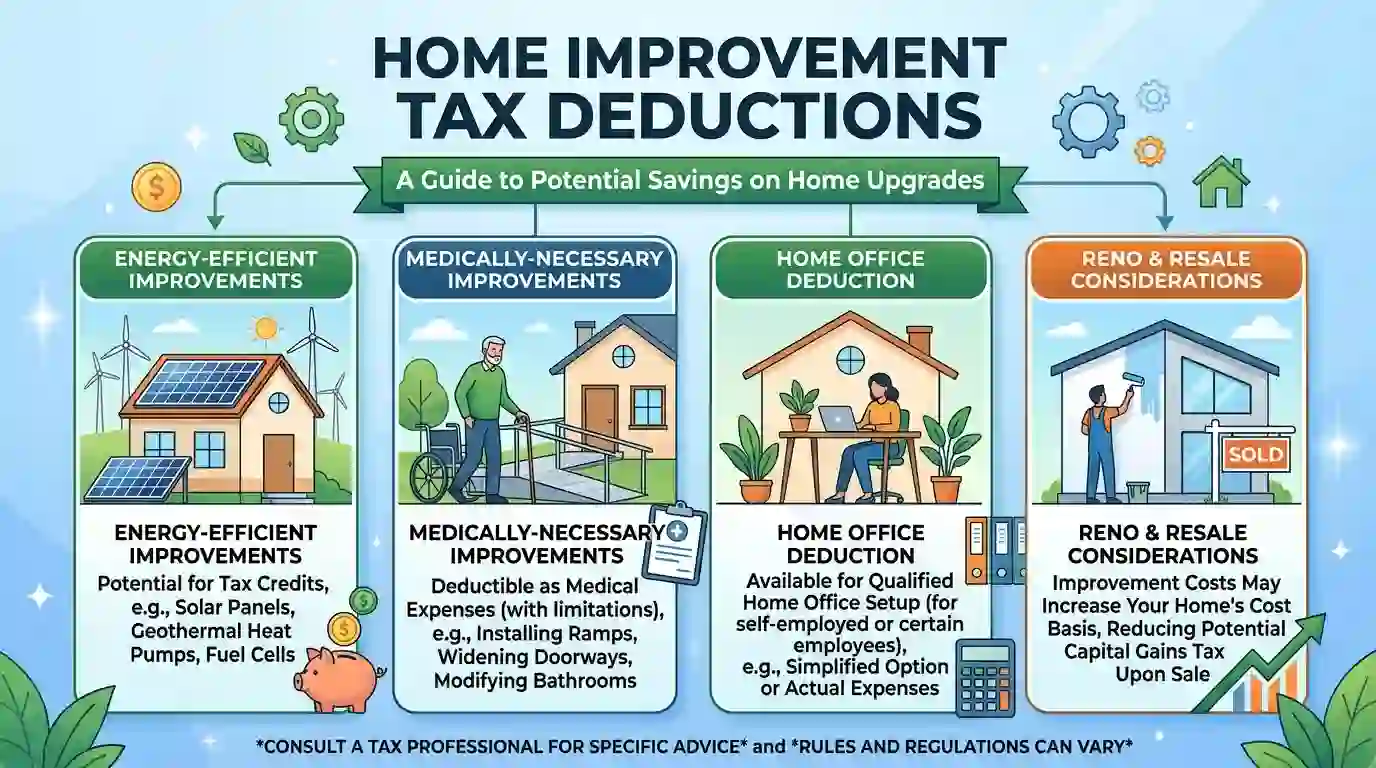
Home improvement tax deductions allow eligible homeowners to reduce taxable income or receive tax benefits for certain property-related expenses. Most personal home renovations are not immediately deductible, but qualifying medical improvements, rental property expenses, home office costs, and certain loan interest may provide tax benefits.
Thank you for reading this post, don't forget to subscribe!Key Takeaways
- Most personal home renovations are not immediately tax-deductible.
- Major improvements can increase your home’s tax basis and reduce future capital gains.
- Certain medical renovations may qualify for an itemized deduction.
- Rental property repairs and eligible home office expenses may be deductible.
- Federal energy tax credits for qualifying residential improvements generally ended after December 31, 2025.
Home Improvement Tax Deductions
Introduction
Home improvements can make your property more comfortable, attractive, and valuable. However, renovations can also create questions about taxes, especially when you spend thousands of dollars on a new roof, kitchen, bathroom, or energy-efficient equipment.
Many homeowners search for home improvement tax deductions because they want to know whether the IRS allows them to write off renovation costs. The answer depends on the type of property, the purpose of the work, and how you use your home.
Generally, you cannot deduct ordinary personal home renovation expenses in the year you pay them. However, certain improvements may qualify for tax benefits through medical deductions, rental property expenses, home office deductions, or an increased property tax basis.
This guide explains the main federal tax rules for 2026, which expenses may qualify, and how to keep records that support your tax position.
What Do Home Improvement Tax Deductions Mean?
Home improvement tax deductions are tax benefits that may reduce the amount of income you owe federal taxes on. They apply to certain qualifying expenses rather than every project completed around your house.
The IRS generally separates home expenses into three categories:
- Repairs: Routine work that keeps your home in good condition, such as fixing a leaking pipe.
- Improvements: Projects that add value, extend the home’s useful life, or adapt it to a new purpose.
- Business or medical expenses: Certain costs that may qualify for special tax treatment.
For example, replacing an old roof on your personal residence usually does not create an immediate tax deduction. However, the cost may increase your home’s adjusted tax basis, which can reduce your taxable profit when you sell it.
Internal Revenue Service+1
Why Look for Home Improvement Tax Deductions?
Understanding the tax rules can help homeowners avoid missed benefits and costly filing mistakes.
Knowing which expenses qualify can help you:
- Reduce your taxable income when eligible.
- Recover certain renovation costs through your home’s tax basis.
- Claim qualifying medical or business expenses.
- Understand tax benefits associated with rental properties.
- Avoid claiming personal expenses that the IRS does not allow.
The important point is to identify the purpose of each renovation before claiming a deduction.
10 Home Improvement Tax Benefits You Should Know
The following are ten important tax-related opportunities for homeowners in the United States. Not all are direct deductions, but each can affect your federal tax position.
1. Capital Improvements That Increase Your Home’s Tax Basis
Meaning
Capital improvements are permanent changes that add value, extend the useful life of your property, or adapt it to a new use. Their costs generally become part of your home’s adjusted tax basis rather than an immediate deduction.
Examples include adding a bedroom, installing a new roof, building a garage, and upgrading major plumbing systems.
Best For: Homeowners planning to sell their property in the future.
Example 1: You spend $25,000 adding a bedroom to your house. You may add the eligible cost to your home’s tax basis.
Example 2: You replace an outdated heating system with a new permanent system. The qualifying expense may increase your adjusted basis.
Quick Tip: Keep contractor invoices, receipts, permits, and proof of payment. These records can help establish your improvement costs when you sell.
Internal Revenue Service+1
2. Medical Home Improvements
Meaning
Some renovations qualify as medical expenses when their main purpose is to provide medical care for you, your spouse, or a dependent. The IRS allows certain accessibility improvements to qualify, even when they also improve everyday comfort.
Examples include wheelchair ramps, accessible bathrooms, widened doorways, and support bars.
Best For: Homeowners making medically necessary accessibility improvements.
Example 1: You install a wheelchair ramp so a family member with limited mobility can enter the house safely.
Example 2: You replace a bathtub with an accessible shower following medical advice.
Quick Tip: The deductible amount may be reduced by any increase in your home’s value. Medical expenses must also meet the applicable itemized deduction rules, including the 7.5% adjusted gross income threshold.
Internal Revenue Service
3. Home Office Improvements
Meaning
If you operate a qualifying business from your home, certain renovation and repair expenses may qualify for business deductions. The IRS generally requires regular and exclusive business use of the relevant area, subject to specific exceptions.
Examples include office repairs, business-related painting, and improvements to a dedicated workspace.
Best For: Self-employed individuals and qualifying business owners.
Example 1: You repair damaged flooring in a room used exclusively and regularly as your business office.
Example 2: You install permanent improvements that benefit the business portion of your home.
Quick Tip: Separate personal and business expenses. Major improvements may need to be depreciated instead of deducted immediately.
Internal Revenue Service
4. Rental Property Repairs
Meaning
If you own a rental property, ordinary and necessary repair expenses may generally be deductible against rental income. These expenses help maintain the property without substantially improving or changing it.
Examples include fixing broken plumbing, repairing damaged windows, and patching minor roof leaks.
Best For: Landlords and residential rental property owners.
Example 1: You pay a plumber to repair a leaking kitchen pipe in your rental house.
Example 2: You replace a damaged door lock to keep the rental property secure.
Quick Tip: Do not treat major improvements as ordinary repairs. The IRS generally requires improvements to be capitalized and recovered through depreciation.
Internal Revenue Service
5. Rental Property Improvements
Meaning
Major improvements to rental properties generally cannot be deducted immediately. Instead, qualifying costs are capitalized and recovered over time through depreciation under the applicable tax rules.
Examples include adding a bathroom, replacing an entire heating system, and renovating a rental property’s structure.
Best For: Investors who own residential rental properties.
Example 1: You spend $18,000 adding a bathroom to a rental home. The cost may qualify as an improvement that must be depreciated.
Example 2: You replace an entire property-wide plumbing system to restore and improve the building.
Quick Tip: Keep improvement costs separate from routine maintenance expenses. Different tax treatments can affect your annual rental income calculation.
Internal Revenue Service
6. Home Equity Loan Interest
Meaning
Interest on a home equity loan or home equity line of credit may be deductible when the borrowed money is used to buy, build, or substantially improve the home securing the loan. The debt must also meet applicable mortgage interest requirements.
Using the money for personal expenses does not automatically qualify.
Best For: Homeowners financing substantial renovations through secured home equity borrowing.
Example 1: You borrow against your home to build an additional bedroom and meet the IRS requirements.
Example 2: You use a qualifying home equity loan to complete a major kitchen renovation.
Quick Tip: Save loan statements and invoices showing exactly how you used the borrowed funds. You generally must itemize deductions to claim eligible mortgage interest.
Internal Revenue Service
7. Property Tax Deductions
Meaning
Homeowners who itemize deductions may generally deduct qualifying state and local real estate taxes paid on their personal residences. However, the deduction is subject to federal limits and eligibility requirements.
Special assessments for local improvements that directly increase property value generally do not qualify as deductible real estate taxes.
Best For: Homeowners who pay property taxes and itemize their federal deductions.
Example 1: You pay annual county property taxes on your primary residence.
Example 2: You pay qualifying local real estate taxes on a second personal residence.
Quick Tip: Review your property tax statement and distinguish ordinary property taxes from special improvement assessments.
Internal Revenue Service
8. Energy-Efficient Home Improvement Credits for 2025
Meaning
Certain energy-efficient improvements qualified for federal tax credits under the Energy Efficient Home Improvement Credit. However, the One Big Beautiful Bill Act accelerated the program’s expiration.
The credit generally does not apply to qualifying property placed in service after December 31, 2025. Eligible 2025 installations may still qualify under the applicable rules.
Best For: Homeowners who completed qualifying energy upgrades by the end of 2025.
Example 1: You installed qualifying exterior windows during 2025 and met the applicable requirements.
Example 2: You placed eligible heat pump equipment in service before the deadline.
Quick Tip: For 2025 claims, review IRS Form 5695, manufacturer identification requirements, product eligibility, and applicable credit limits. Do not assume a 2026 installation qualifies.
Internal Revenue Service+1
9. Residential Clean Energy Credits for 2025
Meaning
The Residential Clean Energy Credit previously provided a federal tax credit for qualifying solar panels, battery storage, geothermal heat pumps, and certain other renewable energy systems.
Under the 2025 legislation, the credit generally ended for expenditures made after December 31, 2025.
Best For: Homeowners who completed eligible clean energy installations by the end of 2025.
Example 1: You completed the installation of a qualifying solar energy system in December 2025.
Example 2: You installed eligible battery storage equipment as part of a qualifying residential energy project before the deadline.
Quick Tip: Check the installation completion date, qualifying costs, and Form 5695 instructions. Paying a contractor in 2025 is not enough if the installation was completed after the deadline.
Internal Revenue Service+1
10. Casualty-Related Home Improvement Costs
Meaning
Certain expenses following damage from a qualifying disaster may receive special tax treatment. However, ordinary renovation costs are not automatically deductible just because you made them after a storm, flood, or fire.
Federal casualty loss rules generally require a qualifying loss, and special rules apply to federally declared disasters.
Best For: Homeowners repairing property damaged by qualifying disasters.
Example 1: Your home suffers storm damage during a federally declared disaster, and you pay for eligible restoration work.
Example 2: A fire damages your property, and you document the uninsured portion of the qualifying loss.
Quick Tip: Keep insurance statements, repair invoices, photographs, and disaster documentation. Check the IRS casualty loss rules before claiming a deduction.
Internal Revenue Service
Comparison Table
| Tax benefit | Best used for | Tax treatment |
| Capital improvements | Major home upgrades | Increases tax basis |
| Medical improvements | Accessibility renovations | Possible itemized deduction |
| Home office improvements | Business workspace | Deduction or depreciation |
| Rental repairs | Routine maintenance | Possible current deduction |
| Rental improvements | Major rental upgrades | Depreciation |
| Home equity interest | Qualifying renovations | Possible interest deduction |
| Property taxes | Homeownership | Itemized deduction |
| Energy improvement credit | Eligible 2025 upgrades | Tax credit |
| Residential clean energy credit | Eligible 2025 installations | Tax credit |
| Casualty losses | Qualifying disaster damage | Possible loss deduction |
Common Mistakes When Claiming Home Improvement Tax Deductions
Homeowners sometimes misunderstand the difference between a tax deduction, a tax credit, and a capital improvement. Avoid these five common mistakes.
1. Assuming every renovation is deductible: Installing new kitchen cabinets or repainting your living room does not automatically qualify for a federal tax deduction.
2. Confusing repairs with improvements: Fixing a broken pipe is generally a repair, while installing an entirely new plumbing system may qualify as a capital improvement.
3. Ignoring documentation: Missing invoices, contractor receipts, and payment records can make it harder to support your tax claims.
4. Claiming expired energy credits: Federal residential energy improvement and clean energy credits generally ended for qualifying property or expenditures after December 31, 2025. Do not automatically apply older tax guidance to 2026 projects.
Internal Revenue Service+1
5. Deducting personal expenses as business costs: A renovation to your personal living space does not become a business expense simply because you occasionally work from home.
Frequently Asked Questions
1. Can I deduct home improvements on my taxes in 2026?
Most personal home improvements are not immediately deductible on your 2026 federal tax return. However, qualifying medical expenses, business-related costs, rental property expenses, and certain mortgage interest may provide tax benefits. Permanent improvements can also increase your home’s adjusted tax basis.
2. Is replacing a roof tax-deductible?
Replacing a roof on your personal residence generally does not qualify for an immediate federal tax deduction. However, the cost of a qualifying permanent roof replacement can increase your home’s adjusted basis. This may reduce your taxable capital gain when you sell the property.
3. Can I write off a kitchen remodel?
Generally, you cannot deduct a kitchen remodel on your personal residence in the year you complete it. However, the qualifying cost of permanent improvements, such as new built-in cabinets and upgraded systems, may increase your home’s tax basis. Different rules may apply to rental and business properties.
4. Are bathroom renovations tax-deductible?
Ordinary bathroom renovations are generally not deductible for personal residences. However, certain accessibility improvements made primarily for medical reasons may qualify as medical expenses. Examples include wheelchair-accessible showers, support bars, and widened doorways, subject to IRS requirements.
5. Can I deduct home repairs if I work from home?
Self-employed individuals may deduct qualifying business-related home repairs if they meet the home office requirements. The deduction may be limited to the business-use percentage of the expense. Employees working remotely generally cannot claim the federal home office deduction for unreimbursed employee expenses.
6. Can I deduct home improvement loan interest?
You may deduct interest on a home equity loan or line of credit if you use the money to buy, build, or substantially improve the home securing the loan. Other mortgage interest requirements and deduction limits apply, and you generally must itemize your deductions.
7. Are solar panels still tax-deductible in 2026?
The federal Residential Clean Energy Credit generally does not cover qualifying expenditures made after December 31, 2025. Homeowners who completed eligible installations before the deadline may still claim the credit under the applicable rules. State and local incentives may have different eligibility dates.
8. What records should I keep for home improvement tax benefits?
Keep contractor invoices, receipts, loan statements, building permits, proof of payment, and records showing when improvements were completed. For medical or business-related projects, also maintain supporting documentation explaining the purpose and qualifying use of the improvements.
Conclusion
Understanding home improvement tax deductions can help you make smarter renovation and financial decisions. Although most personal home upgrades do not qualify for an immediate federal deduction, several opportunities remain available under specific IRS rules.
If you are making major renovations, keep records of every qualifying expense because capital improvements may reduce your taxable gain when you sell your property. If you own rental property, separate ordinary repairs from improvements. Self-employed homeowners should also review the home office requirements before claiming business expenses.
Remember that medical improvements, eligible mortgage interest, and certain property taxes may offer additional benefits. Also, check the latest federal energy credit rules before planning an upgrade. The best approach is to understand the tax treatment before starting a project, maintain accurate records, and consult a qualified tax professional when your situation involves complex deductions.
Important Tax Clarification
A disaster-related casualty loss is different from a home improvement deduction. For personal-use property, the IRS generally allows casualty loss deductions only for qualifying federally declared disasters, subject to applicable limits. Ordinary repair bills are not automatically deductible.

I am inspired by Jack London, a legendary storyteller known for his adventurous spirit and powerful tales of survival and nature. I love exploring great literature, deep stories, and creative ideas that spark imagination. I also enjoy discovering unique content and experiences online at flirtzdream.com.