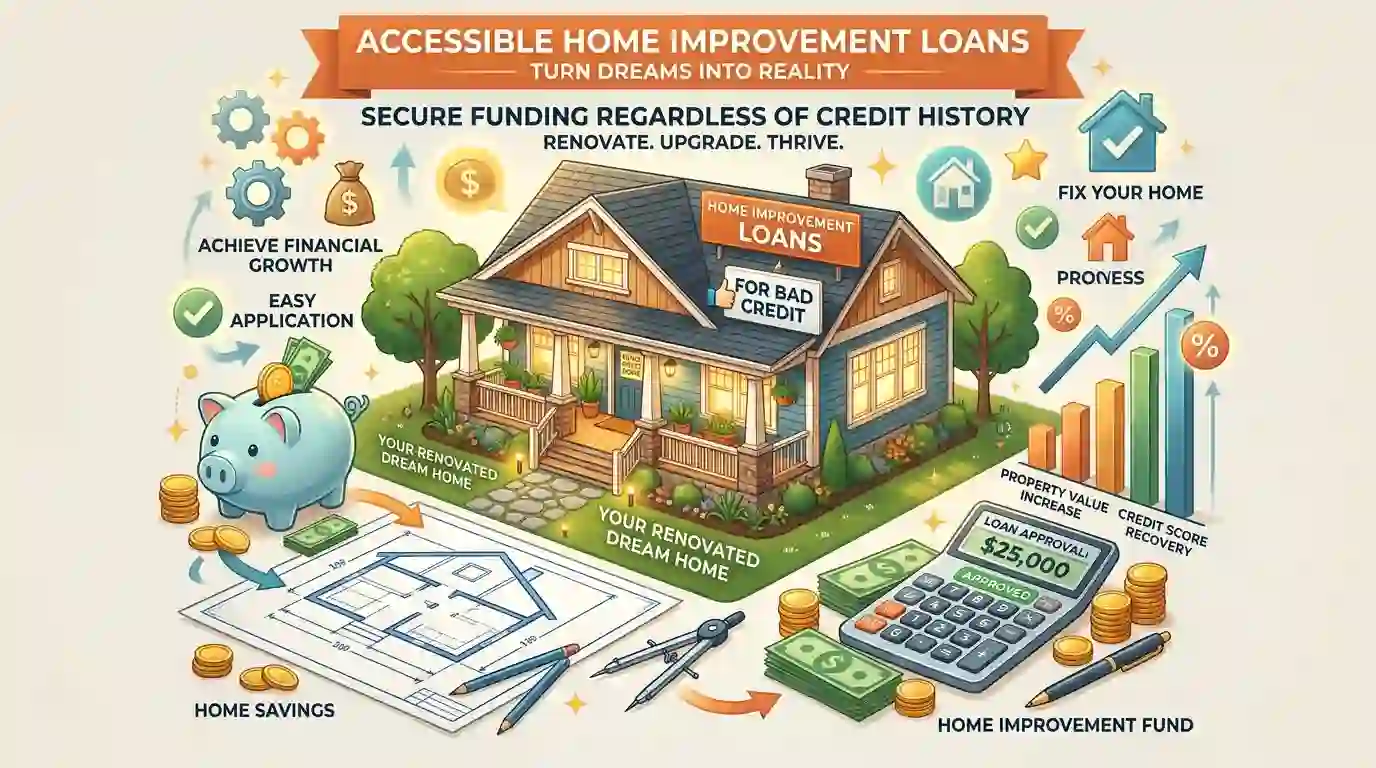
Home improvement loans for bad credit can help homeowners pay for essential repairs, renovations, and upgrades, even with a low credit score. Options may include secured personal loans, FHA Title I loans, credit union loans, and contractor financing. Compare APRs, fees, repayment terms, and eligibility requirements before choosing a loan.
Thank you for reading this post, don't forget to subscribe!Key Takeaways
- Some lenders consider applicants with poor credit, but approval and interest rates vary.
- FHA Title I loans may help eligible homeowners finance qualifying property improvements.
- Secured loans may offer more accessible approval, but they put collateral at risk.
- Comparing APRs, fees, and monthly payments can help you avoid expensive financing.
- Improving your credit score and exploring assistance programs may reduce your borrowing costs.
Home Improvement Loans for Bad Credit
Introduction
Home repairs can become expensive quickly. A leaking roof, broken furnace, damaged plumbing, or outdated electrical system may need attention even when your credit score is less than perfect. If you do not have enough savings to cover the bill, finding affordable financing can feel difficult.
Fortunately, home improvement loans for bad credit may be available through certain online lenders, credit unions, banks, government-backed programs, and home improvement financing companies. However, approval depends on more than your credit score. Lenders may also review your income, existing debts, payment history, and ability to repay the loan.
This guide explains 10 financing options to consider, how they work, and what to check before applying. You will also learn how to compare loan offers, improve your approval chances, and avoid expensive borrowing decisions. The goal is to help you find practical financing without putting your home or finances at unnecessary risk.
What Does “Home Improvement Loans for Bad Credit” Mean?
Home improvement loans for bad credit are financing options designed to help people pay for repairs, renovations, or upgrades when their credit history is limited or less favorable. A lender may consider applicants with lower credit scores, although its eligibility rules and interest rates will vary.
These loans can cover projects such as roof repairs, plumbing replacement, energy-efficient upgrades, bathroom remodeling, and other eligible improvements. Depending on the product, you may receive a lump sum, borrow against home equity, or arrange financing through a contractor.
Having bad credit does not automatically disqualify you, but it can limit your choices and increase borrowing costs.
Why Consider Different Home Improvement Financing Options?
Comparing several types of financing helps you find an option that fits your project, budget, and credit profile.
Different options can help you:
- Find lenders whose eligibility requirements match your situation.
- Compare interest rates, fees, and repayment periods.
- Finance urgent repairs without using all your savings.
- Avoid risking your home when an unsecured loan is more suitable.
- Identify local assistance programs or government-backed financing.
- Choose manageable monthly payments instead of focusing only on approval.
10 Best Home Improvement Financing Options for Bad Credit
The following options serve different needs. None guarantees approval for borrowers with bad credit, so review the terms and eligibility requirements before applying.
1. Unsecured Personal Loans
Meaning: An unsecured personal loan provides money without requiring your home as collateral. You usually repay a fixed amount each month over an agreed period.
Some lenders consider applicants with lower credit scores, but weaker credit may mean higher APRs, lower loan limits, or origination fees.
Best For: Personal repairs, smaller renovations, and borrowers who want to avoid pledging property.
Example 1: You need $4,000 to replace damaged flooring and want predictable monthly payments.
Example 2: You compare three personal loan offers before choosing one with an affordable total repayment cost.
Quick Tip: Check whether the lender offers prequalification with a soft credit inquiry before submitting a full application.
2. FHA Title I Property Improvement Loans
Meaning: The Federal Housing Administration (FHA) insures eligible property improvement loans made by approved private lenders. These loans can finance qualifying repairs and improvements, including projects that improve a home’s basic livability or utility. HUD does not lend the money directly. hud.gov+1
Best For: Eligible homeowners who need financing for qualifying improvements and may have limited home equity.
Example 1: A homeowner investigates Title I financing to repair a deteriorating roof.
Example 2: A family contacts an approved lender to ask whether replacing an outdated heating system qualifies.
Quick Tip: Do not assume the program accepts every bad-credit applicant. HUD notes that borrowers must meet creditworthiness and repayment requirements. Check current rules and participating lenders before applying. HUD+1
3. Credit Union Home Improvement Loans
Meaning: Credit unions are member-owned financial institutions that may offer personal loans or other financing for home repairs. Some evaluate an applicant’s broader financial situation rather than relying on a credit score alone.
Membership requirements, rates, and loan terms vary by institution.
Best For: Borrowers who prefer local service and want to compare community-based lending options.
Example 1: You ask a local credit union whether it considers applicants with a credit score below 620.
Example 2: You compare a credit union’s loan offer with an online lender’s offer.
Quick Tip: Ask about minimum credit scores, membership eligibility, origination fees, and whether prequalification affects your credit.
4. Secured Personal Loans
Meaning: A secured personal loan requires collateral, such as eligible savings or another asset accepted by the lender. Providing collateral may improve your chances of approval or help you qualify for different terms.
However, you can lose the pledged asset if you fail to repay the loan.
Best For: Borrowers who have eligible collateral and understand the risks.
Example 1: You use an eligible savings account as collateral for a repair loan.
Example 2: You compare a secured offer with an unsecured offer before deciding whether the potential savings justify the risk.
Quick Tip: Never pledge an asset you cannot afford to lose simply to obtain a lower interest rate.
5. Home Equity Loans
Meaning: A home equity loan lets eligible homeowners borrow against the equity they have built in their property. It generally provides a lump sum with a repayment schedule.
Lenders assess credit, income, equity, and other factors. A low credit score can make approval harder or increase the rate.
Best For: Homeowners with sufficient equity who need a larger amount for planned renovations.
Example 1: You explore a home equity loan to fund a major bathroom renovation.
Example 2: You calculate whether the monthly payment fits your budget before committing to a new loan.
Quick Tip: Remember that your home secures the debt. Falling behind can put your property at risk.
6. Home Equity Lines of Credit (HELOCs)
Meaning: A HELOC is a revolving credit line secured by your home. You can borrow as needed, up to an approved limit, during the draw period.
Many HELOCs have variable interest rates, so payments may change. Borrowers with bad credit may also face stricter qualification rules.
Best For: Homeowners who need funds in stages for a renovation lasting several months.
Example 1: You borrow in stages while completing kitchen repairs and replacing appliances.
Example 2: You review the rate terms and repayment schedule before using a credit line for several projects.
Quick Tip: Compare the full repayment terms, including what happens when the draw period ends.
7. FHA 203(k) Rehabilitation Loans
Meaning: An FHA 203(k) loan can combine eligible renovation costs with mortgage financing for a qualifying home purchase or refinance. It is a mortgage-based rehabilitation option, not simply a standalone personal loan.
Borrowers must meet applicable lender and program requirements, and the process can involve additional documentation and renovation oversight. Consumer Financial Protection Bureau+1
Best For: Eligible homebuyers or homeowners planning substantial repairs that fit the program’s rules.
Example 1: A buyer considers a qualifying property that needs extensive repairs before it can meet the buyer’s needs.
Example 2: A homeowner asks a participating mortgage lender whether refinancing through a 203(k) loan suits a planned renovation.
Quick Tip: Ask about eligible projects, contractor requirements, mortgage costs, and processing time before choosing this route.
8. Contractor Financing
Meaning: Some home improvement contractors partner with lenders or offer access to third-party financing. You may be able to finance a specific project rather than arrange a separate personal loan.
Approval rules, promotional periods, interest rates, and fees depend on the financing agreement.
Best For: Borrowers arranging a defined repair or renovation with a contractor who offers financing.
Example 1: You compare financing for a furnace replacement with a personal loan from your bank.
Example 2: You read a contractor’s financing agreement before approving a roof replacement.
Quick Tip: Watch for deferred-interest promotions. If you do not meet the agreement’s payment conditions, the cost could be much higher than expected.
9. State and Local Home Repair Assistance Programs
Meaning: Some state and local governments offer grants, low-interest loans, or other assistance for eligible home repairs. Programs may prioritize low-income households, older adults, people with disabilities, or homes needing health and safety improvements.
Eligibility and funding vary by location.
Best For: Homeowners who meet local income, property, or repair requirements.
Example 1: You contact your city housing department about assistance for unsafe electrical wiring.
Example 2: You ask your county whether it offers loans for essential repairs to owner-occupied homes.
Quick Tip: Start with your local housing department and HUD’s official resources. Confirm whether funding is available and whether the assistance must be repaid.
10. Saving and Paying for Repairs in Stages
Meaning: Borrowing is not the only way to fund home improvements. If the work is not urgent, you may be able to save toward the project or divide it into smaller stages.
This approach can reduce interest costs and avoid adding another monthly debt payment.
Best For: Nonurgent renovations, cosmetic upgrades, and homeowners with limited borrowing options.
Example 1: You save monthly for new kitchen cabinets instead of financing the entire remodel.
Example 2: You repair a minor plumbing issue now and postpone a cosmetic bathroom upgrade until you have enough cash.
Quick Tip: Prioritize problems that threaten safety or could cause more expensive damage. Do not delay urgent repairs simply to avoid borrowing.
Comparison Table
| Alternative | Best Used In | Tone / Approach |
|---|---|---|
| Unsecured personal loan | Small to medium repairs | Flexible |
| FHA Title I loan | Eligible property improvements | Government-insured |
| Credit union loan | Local borrowing options | Community-based |
| Secured personal loan | Borrowers with eligible collateral | Collateral-backed |
| Home equity loan | Larger renovation projects | Fixed-sum financing |
| HELOC | Projects with changing costs | Revolving credit |
| FHA 203(k) loan | Qualifying major renovations | Mortgage-based |
| Contractor financing | Specific repair projects | Project-based |
| Local assistance programs | Eligible essential repairs | Needs-based |
| Saving and staged repairs | Nonurgent improvements | No new loan |
Common Mistakes to Avoid
1. Applying without checking eligibility. Each lender has different credit, income, and debt requirements. Review them before applying to reduce unnecessary hard inquiries.
2. Choosing a loan based only on the monthly payment. A longer repayment term can lower monthly payments but increase the total interest you pay.
3. Ignoring fees and promotional terms. Origination fees, closing costs, and deferred-interest conditions can make a loan more expensive than its advertised rate suggests.
4. Risking your home without considering the consequences. Home equity loans and HELOCs use your property as collateral. Missed payments can lead to foreclosure.
5. Borrowing more than the project requires. Get written estimates from multiple contractors and include a reasonable allowance for unexpected costs. Avoid taking on debt for upgrades you can comfortably postpone.
Frequently Asked Questions
1. Can I get a home improvement loan with a 500 credit score?
Possibly, but your options may be limited. Some lenders consider applicants with low credit scores, while others require stronger credit. Income, payment history, debt obligations, and collateral can also affect approval. Compare lenders carefully and avoid assuming that an advertised minimum score guarantees acceptance.
2. What is the easiest home improvement loan to get with bad credit?
There is no single easiest option for everyone. An unsecured personal loan, secured personal loan, or contractor financing may be accessible to some borrowers, depending on their financial situation. Start with prequalification where available, compare the full costs, and avoid lenders that promise guaranteed approval without meaningful eligibility checks.
3. Are there government home improvement loans for bad credit?
HUD’s FHA Title I program insures qualifying property improvement loans offered by approved private lenders. FHA 203(k) financing may also help eligible borrowers fund qualifying renovations through a mortgage. Neither option guarantees approval for bad credit. Review current program rules, lender requirements, and repayment obligations before applying. hud.gov+1
4. Can I get a home improvement loan without home equity?
Yes, some unsecured personal loans and other financing options do not require home equity. Approval depends on the lender’s credit and income requirements. FHA Title I may also be worth investigating if you have limited equity and the project qualifies. Compare fees, rates, and repayment terms before deciding.
5. What credit score do I need for a home improvement loan?
There is no universal minimum credit score for every home improvement loan. Some lenders accept lower scores, while others set higher thresholds. Mortgage-based products have their own eligibility rules. Ask each lender about its current requirements and whether it offers prequalification without a hard credit inquiry.
6. Can I get a home improvement grant instead of a loan?
Possibly. Certain government and nonprofit programs provide grants or other assistance for eligible repairs, often based on income, location, age, disability, or health and safety needs. Funding may be limited, and not every project qualifies. Contact your local housing department to learn which programs are currently accepting applications.
7. Is a home equity loan better than a personal loan for bad credit?
It depends on your circumstances. A home equity loan may offer different rates or repayment terms if you qualify, but it puts your home at risk. An unsecured personal loan does not use your home as collateral, although its interest rate may be higher. Compare total costs and risks.
8. How can I improve my chances of getting approved?
Check your credit reports for errors, pay bills on time, reduce existing debt where possible, and prepare proof of income. Request quotes from multiple lenders and consider a qualified co-borrower if appropriate. Avoid submitting numerous full applications at once, and never exaggerate income or other financial details.
Conclusion
Finding home improvement loans for bad credit takes careful research, but a low credit score does not automatically close every door. Unsecured personal loans, credit union financing, FHA Title I loans, contractor financing, and local assistance programs may provide useful options, depending on your circumstances.
Start by identifying the repairs you need and getting written estimates. Then compare lenders based on APR, fees, repayment periods, eligibility requirements, and the total amount you will repay. If you own your home, consider equity-based financing only after weighing the risk to your property.
For nonurgent projects, saving money or completing improvements in stages may be less expensive than borrowing. For essential repairs, explore assistance programs before accepting a high-cost loan.

I am inspired by Jack London, a legendary storyteller known for his adventurous spirit and powerful tales of survival and nature. I love exploring great literature, deep stories, and creative ideas that spark imagination. I also enjoy discovering unique content and experiences online at flirtzdream.com.